


"I'm still in the program, and I'm not doing anything with it."
"And I'm paying."
"A lot of money."
A founder said that to Ric, my husband and co-founder, in September. She sells a high-end service, 1:1, and the program she pays for runs on a drill of 100 outreach messages a day. She thinks the coach who sold it to her is the best there is, but she's still not using it.
This month the coaching industry doubled down on vetting the coach: a new network that verifies every coach's credential before they join, and a new exam for the senior credentials. Nobody vets whether the program matches the founder who's actually paying for it.
If you'd rather have a diagnosis BEFORE you're given the prescription, subscribe. It's free.
The drill that never fit her
She joined, in her words, "Because I want to learn how to speak in front of people."
As for why that program, out of all of them: "first of all, she's a heck of a seller, so I think she's the best."
Then she described the drill: "okay, this is the drill, you're gonna reach out to 100 people a day, you're gonna do that…"
And her verdict on it: "this grinding never worked for me."
"Since March, I've been battling, and I haven't been able to do anything with it."
Ric asked what it cost. Her answer was 5 figures, every year.
She took some of the blame in the same sentence, the way highly competent founders usually do: "And I know it's been also my fault." Then she finished it: "but I don't think the way the structure [works] is for me."
The second half of that sentence is the diagnosis. Nobody wrote it down before they wrote the prescription.
Meanwhile, the industry is checking the coach
On November 12th, Chief launched "COACHING, Powered by Chief," open to leaders outside its membership for the first time, with more than 80 executive coaches. The promise in the press release: "Every coach holds an International Coaching Federation (ICF) or equivalently accredited credential," "verified by Chief before a coach joins the network."
Two days earlier, on November 10th, the ICF opened its new PCC-MCC Exam.
That's a fair check, and a credential is a fair way to make it. Somebody trained, somebody sat a test, somebody verified it.
But look at what it checks.
The coach.
Her story has no bad coach in it. She thinks her coach is the best there is.
That coach may hold every credential going - the transcript doesn't say, and it wouldn't change a thing anyway. A brilliant, fully qualified coach can still hand you somebody else's prescription.
A credential vets the coach. It has never once vetted the fit to the person footing the bill.
3 things nobody checked
She named every one of them herself, in a single call.
How she's built. "I'm built in a certain way, and I just… I'm not the grinding type of human." A drill of 100 outreach messages a day was built for somebody. It was never fitted to her.
Who actually pays her. She sells a high-end service, 1:1, and the plan in front of her looked like this: "how do I pay my bills if I'm reaching out to 500 people to buy a $30 offer." A minute later she said it straight out: "So, yes, I'm in a wrong market. I'm talking to the wrong market." That's her Business Clock and her Market Clock pulling against each other: what she sells needs a few clients who can pay a lot, and the plan pointed her at a crowd buying $30 offers. And the line that should be printed on every enrollment form in the industry: "Now, nobody told me at which scale. 10 people for $30,000 each, or thousands of people for $100 each? Nobody told me that."
Whether she had the time. What the program tells its members, as she tells it: "in the first year, you're figuring things out." Her answer: "I don't have the time." That's her Personal Clock - the year she's actually living, with the attention and energy she actually has - and the program set its own clock without asking about hers.
That's an Undiagnosed Prescription. The program was written before anyone looked at who was sitting in the chair, what she sells, or where she is in her year.
To be fair to the program, she said this too: "it works for a lot of people, it just didn't grab me." I believe her.
Some programs are great. A program aimed at the problem you actually have, and built to fit how you work, can be exactly the right spend.
Last week I gave them a name: the Cookie-Cutter Consultants, who sell the same program to everyone and never check which founder is standing in front of them.
A spare year is a World Clock question too
"In the first year, you're figuring things out" sounds patient. It also assumes the year is yours to spend simply "figuring things out."
Look at the year it's being spent in. In the NFIB's October survey, released November 10th, a net 37% of small-business owners said they plan to raise prices - the most in more than 4 years. And Subchapter V filings, the small-business track of Chapter 11 bankruptcy, were up 46% for January through September against the same months of 2025, per Epiq AACER via the ABI.
That's the World Clock, and a squeeze year shortens how long any founder can wait for a plan to pay, whoever their clients are. A program that budgets a year for figuring things out was set by a clock that isn't yours.
This isn't only her story
You don't have to be paying 5 figures to have been here.
If you've ever been sold the plan the whole room swore by - the outreach drill, the course, the stage - by someone who was very good and very qualified, and it never once felt like yours... you already know what got skipped. Nobody checked how you're built, who actually buys from you, or where you were in time when you signed.
If you're a coach yourself, this may be your story twice over: the program you bought, and the one your clients bought before they found you.
Before you renew anything this year
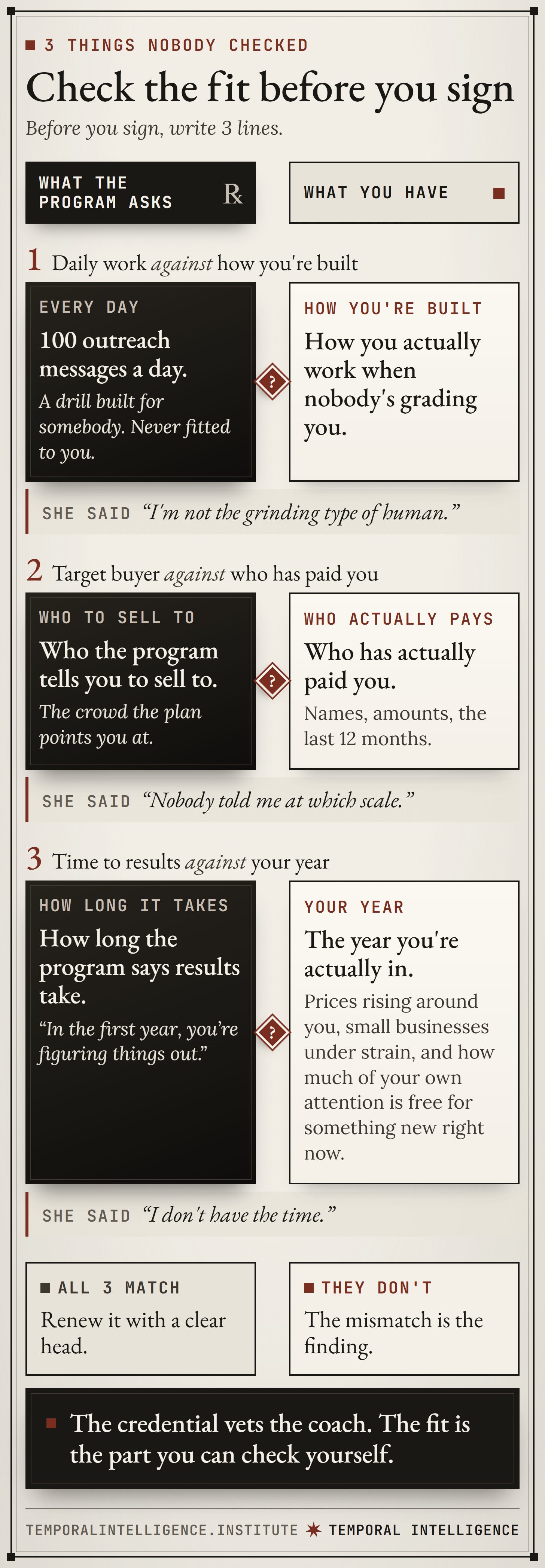
Some of you have a renewal notice in your inbox right now, or a 2027 program pitch sitting next to your plan. Before you sign, write 3 lines.
Line 1. What the program asks you to do every day. Next to it, how you actually work when nobody's grading you.
Line 2. Who the program tells you to sell to. Next to it, who has actually paid you - names, amounts, the last 12 months.
Line 3. How long the program says results take. Next to it, the year you're actually in: prices rising around you, small businesses under strain, and how much of your own attention is free for something new right now.
If all 3 lines match, renew it with a clear head. It works for a lot of people, and it may well be working for you.
If they don't match, a better-credentialed coach won't fix it. Neither will trying harder at a drill that was never fitted to you. The mismatch is the finding. Take it to whoever's selling you the next year and see whether they ask about it... or just hand you the pen.
The credential vets the coach. The fit is the part you can check yourself, tonight, with your own numbers - before anyone writes you another prescription.
If you'd rather check the fit before you sign the renewal, subscribe. This is where I write about how you're built and where you are in time, before anyone hands you an answer designed for someone else.
Send this to a founder who's still paying for a program they haven't opened since summer.