



Institute for Temporal Intelligence · Field Case Studies
Subject: “Diane.” Diagnostic delivered 2026-06-05. Anonymized at the client’s request.
She bought a business doing $3M a year.
At the time of the diagnostic, it was doing $100K over the trailing 12 months. Paid acquisition had been switched off for 12 months because the unit economics no longer recovered the spend. Across a catalog of 40 products, nothing sold above $747.
The category was growing the entire time. The tier she was competing in was not. That tier was compressing from both directions, while the tier her product actually belonged to was opening faster than supply could meet it, on a window her own diagnostic put at 6 to 12 months before it crowded.
The expensive wrong answer she had already bought
She had been through this once already, at a price.
“I probably spent over 20,000 with them.”
“It was a lot of money for nothing, quite frankly.”
“I spent a lot of money with [a top-tier business program] and his group, and they didn’t do anything like this.”
That is worth sitting with before anything else in this case, because it establishes what the diagnostic was competing against. Not ignorance. A $20,000 prior attempt by a program with a real track record, run by people who are not stupid, which produced nothing she could use.
What the diagnostic actually did
The Temporal Read does not run a single analysis. It runs 4 independent analyses of the same business, each conducted on its own evidence and none of them written to agree with the others, then tests what they return against 2 further sources: her own product-level sales data, and a working session with her. What it acts on is only what all 6 agree about.
Here is what each read returned on its own.
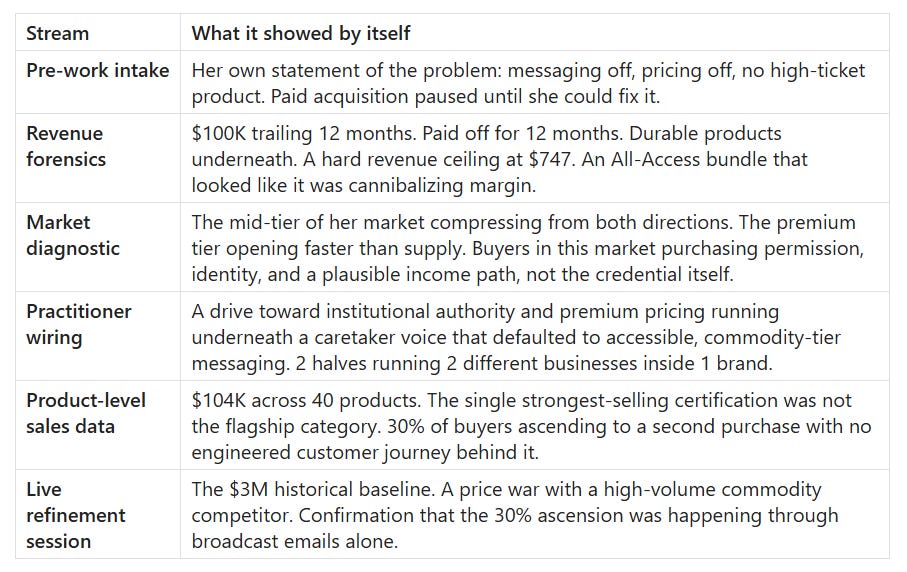
Any 1 of those reads, taken alone, produces a competent and wrong answer.
Revenue forensics alone says cut the bundle. The market diagnostic alone says raise prices. The wiring read alone says her messaging is fighting her own instincts. The product data alone says double down on the best seller. Each of those is defensible. Each of them, executed, would have moved the business sideways at best.
The findings that matter showed up only where the streams overlapped.
The 2 reframes that only convergence produced
The bundle was not the problem. It was the only thing holding the business together.
Read against revenue alone, the All-Access bundle priced below the sum of its parts is textbook cannibalization, and the obvious move is to kill it or reprice it. Read against the media constraints surfaced in the market diagnostic, it inverted. Some of her modalities could be acquired through paid traffic. Others could not, because the ad platforms restrict the category. The bundle was the only structural bridge between a front end she could buy traffic for and a back end she could not. Killing it would have severed the business from its own back catalog.
That reframe is not reachable from the revenue data. It is only reachable when the revenue data is held against the platform terrain at the same time.
The 30% ascension rate was a floor, not a ceiling.
30% of her buyers were already moving to a second purchase. There was no engineered journey producing that. No sequence, no ladder, no designed ascension. It was happening through broadcast emails to a list.
Held against the market diagnostic, that number changed meaning entirely. The premium tier of her market was opening, and 30% of her existing buyers were already self-selecting toward a multi-modality path she was not selling and had never built. Read that way, the 30% became demand-side evidence: the buyers for a business she was not running were already sitting inside her own list.
A funnel audit finds the 30% and builds a sequence. The convergence read finds the 30% and identifies which business she should be in.
She pushed back
The paths document went to her as a redline. 6 structural options, unranked, with instructions to mark each one and to say what was missing.
She marked 2 of the 6 with an X.
Path 3: “Too incremental for the larger vision or exit goals. Not enough differentiation.”
Path 4: “Too narrow despite [the differentiating modality] being a valuable differentiator.”
She marked 2 more as staged for later rather than now.
Then she corrected the analysis. The report had underweighted her team and had modeled her as a solo founder. She was not one. Her own contribution was 20 to 30 hours a week, with a team executing around her, which made phased execution, mentorship delivery, and premium fulfillment materially more realistic than the report had assumed. That correction went back into the sequencing.
And having argued with it, she adopted it:
“The report feels directionally very accurate. The core insight that [the business] is structurally stronger than its current positioning is true. The issue does not feel like a failing market or broken business. It feels more like a positioning, pricing, and category-perception issue.”
That sequence is the part of this case study worth the most. A diagnostic that cannot be argued with is not a diagnostic. She read it, rejected a third of it, corrected the model of her own operation, and then signed off on the structure. Nobody was handled.
There is a short read that sorts a business into 1 of 5 structural families. It takes a few minutes, it asks about your business rather than telling you about hers, and it names the family you are in.
It does not name your constraint. Naming a constraint takes the full instrument and your real numbers. What it will tell you is which of the 5 you are arguing with.
What she decided
She confirmed a staged sequence: reposition first, with a limited founding practitioner circle running alongside it, and the full integrated ecosystem held for a later stage. In her words, the business needed an evolution “from a low-tier online certification company into a more premium transformational education ecosystem.”
And she named a number she had not walked in with: $500K minimum annual revenue before she leaves her day job, scaling toward $1M and above.
That number is the outcome that matters. Before the diagnostic she had 3 symptoms and no threshold. After it she had a threshold, a sequence, and a stated condition for the largest decision in her professional life.
Her own valuation
“Easily a $15K product.”
“I know what I’m thinking, and I wanted this over a year ago.”
“I enjoyed reading through the structural architecture, learning the different seven systems and learning about myself. I thought it was a great piece.”
Asked directly whether it had been more useful than the $20,000 she had already spent elsewhere, she said: “Definitely.”
On the final call, with every report in hand:
"For me - it's been things I've been thinking of the past couple of years, and it brought clarity and confirmation that I was on the right path and I really needed that."
Those are her figures and her assessment of the work’s worth.
What the $20,000 program did not find
The finding, stated plainly, was a category error. She had inherited a boutique multi-modality school and had been pricing, marketing, and competing as a commodity credential factory against a high-volume competitor. The race to the bottom on price collapsed the floor across the entire catalog, which collapsed paid acquisition, which collapsed everything downstream. Her practitioners were never credential holders. They were practitioners whose work changes lives, and the business had never been priced or described as if that were true.
Pricing, messaging, and positioning had to move together, because the promise determines all 3.
A positioning consultant can reach that conclusion. That is not the interesting part of this case.
The interesting part is that the conclusion was not visible in any single stream. It was not in her revenue. It was not in her market. It was not in her product mix, her wiring, or her own account of the problem. Each of those, read alone, produced a different and plausible answer, and 1 of those answers had already been bought for $20,000 and had not worked.
It was visible only in the overlap. 4 independent analyses, 2 further sources testing them, 6 of 6 in agreement on 1 structure. That convergence is the method, and the category finding is what the method returned.
There is a short read that sorts a business into 1 of 5 structural families. It takes a few minutes, it asks about your business rather than telling you about hers, and it names the family you are in.
It does not name your constraint. Naming a constraint takes the full instrument and your real numbers. What it will tell you is which of the 5 you are arguing with.
*Anonymized institutional case study. Client alias used at her request. Figures are the client’s own, reported during the diagnostic process.
