



Everybody’s carrying a few. Gifted. Not a math person. High potential. Needs supervision. Not a closer. A little too much. A great number 2 - not a real leader.
Somebody handed you each one, in a particular building, in a particular year. And you kept it... long after the building and the year were gone.
In the last few weeks, 3 arguments about labels made the news. They’re worth reading side by side.
In New Jersey, the state moved to a new adaptive test, and its Board of Education approved new cut scores for every grade. About 47% of third graders showed proficiency in grade-level reading. The state was candid about what that number can tell you. Lisa Haberl, who runs teaching and learning at the state education department: “These results represent a new starting point, rather than a direct continuation of previous years’ data.”
So some of what changed on a child’s report this year is the child. Some of it is where the state decided to draw a line.
In the UK, an independent review of ADHD and autism support, published October 9th, found that “’Diagnosis’ has become the primary gateway to support that could and should be available earlier.” The help sits behind the label, so families go and get the label. Now they’re worried about over-diagnosing.
And in the US, John Stossel’s column “Un-Gifted and Talented” (September 23rd) defends gifted programs and sorting by test. “Testing, then putting kids on different tracks was standard when I was in school,” he writes. The researcher he interviews, Michael Petrilli, argues a test is less biased than a teacher’s recommendation.
On that narrow point I’d mostly agree with them. My own test scores were never the problem.
Read the 3 together, though, and they’re one argument. New Jersey is changing the labels. The UK is gating help on a label. Stossel is defending the labels. The whole fight is over WHICH label, who gets it, and what it unlocks.
Nobody in it is asking whether the label measured the person... or the moment the person was measured in.
I’d have liked someone to ask that when I was 7.
I grew up a military brat, and we moved A LOT. Every new school sorted me again - and not in the fun Harry Potter Sorting Hat way...
My test scores were always off the charts. In 2nd grade, on the strength of them, I was put in the 5th graders’ Reading class. 5th graders did NOT appreciate a 2nd grader in their class, so most days I tried to hide in the bathroom.
In the 5th grade they decided I should NOT be in the gifted program at one school because I forgot to bring my pencils to the testing room. While my academics were great my “responsibility” was lacking. My mother was very disappointed.
I took algebra for 4 years, because each school system I attended from 6th-9th grade introduced it at a different time. In 8th grade the gifted algebra teacher kicked me out of her class. I was bored, having taken it before, and she decided I was resting on my laurels and couldn’t focus. They put me in remedial 8th grade math. I slept through most of that year.
Gifted in one school. Remedial in the next. Same kid, same scores.
The label was more about the place, not the person.
You probably have a version of this too.
Maybe it was at school.
Maybe it was the manager that decided you were lazy, the year your father was sick.
Or maybe it was the investors who turned you down when you pitched them 3 months after the market turned.
Somebody wrote it down that time, and it’s been describing you ever since.
Our house has a full set of school calamities.
Ric hated doing things just because he was told to, and if he could already do the work, he saw no point in doing the homework. His teachers and parents were not amused.
Chandler and Stefan, our sons, were forced to walk their elementary school halls single file, 2 tiles from the wall... in silence. We MUST have order after all - and wild little boys are the enemy of order.
Everybody got sorted, stamped and homogenized.
The sorting never asked what was actually going on in our lives at the time, or even if we wanted to be weighed, measured, and found wanting.
Here’s the simplest way I know to say what a label is.
A label is a postmark.
It tells you, fairly accurately, where and when you were measured. Which school, which test, which manager, which year. What it can’t tell you is what’s inside the envelope.
The trouble starts when everyone reads the postmark as the contents of the letter.
“Remedial” may have been a fair description of a bored 8th grader who’d already taken algebra 3 times, sitting in that one room.
It was a lousy description of me.
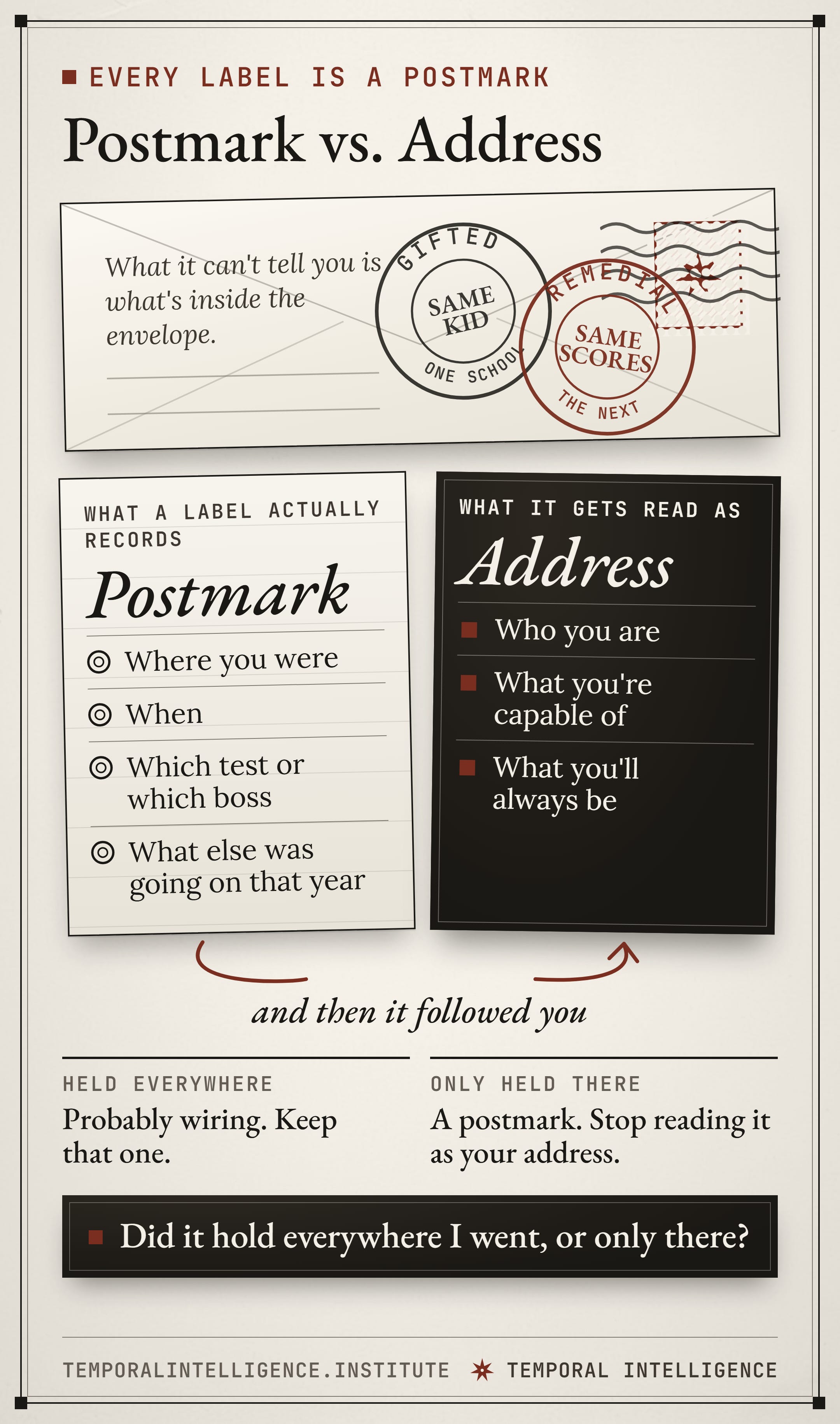
The map is not the territory. And the label is not the person.
That’s the gap the 2 words we use in our work are built for.
Typecasting assigns you a role from someone else’s script. And you play that role forever.
Timecasting discovers who you are and the role you’re living now.
The first reads the postmark and files you. The second reads you and where you were standing when the stamp came down, and then asks where you’re standing today.
Some labels hold up. If one followed you through 6 schools and 3 jobs, under bosses who never met each other, it’s probably telling you something true about how you’re built. Keep that one.
The rest are worth re-reading. And there’s a good stretch coming up to do it in.
From Saturday the 24th to November 13th, a review season opens. Year-end reviews get written. Old files get opened. People hand you their verdicts, and you hand out a few of your own.

So use it to re-read your labels.
Write down 3 you were handed, at school or at work.
Next to each, write where you were, what year it was, and what else was going on that year.
Then ask each one a single thing: did it hold everywhere I went, or only there?
The ones that are held everywhere are probably wiring. The ones that were only held in one building, one year, under one boss... those are postmarks. Stop reading them as your address.
And if you’re the one writing the reviews this time, put a date on each verdict. You’re measuring a person in a moment. Say which moment.
Subscribe - it’s free - for more on the when half: what’s shifting, when, and how to tell in your own life and business.
Forward this to someone who’s still carrying a label from a building they left 20 years ago.