


Nobody got worse.
That’s the part people skip when they tell a failure story, because it’s more comfortable to go find the mistake than to sit with the fact that there wasn’t one.
Ric - my husband and business partner - and I ran an information-products business for years. Ordinary tickets, nothing exotic, average sale somewhere around $20.
Then it fell apart, and not gradually.
He’s told this story enough times now that I can give you the sentence he always gets to.
“It’s the same offers. It was the same me, it was the same Liz, it was the same team, same tech, all that stuff. We didn’t get worse at this, right?”
And then the sentence after it, which is the one that matters:
“But something underneath it did. Something shifted.”
If it wasn’t him, and it wasn’t the offer, and it wasn’t the team, then what changed was the water the offer was swimming in.
And water you can date.
That’s the whole idea, in a sentence. Experience doesn’t expire. It dates.
A pattern you learned is a genuine observation about a genuine set of conditions, and it stays true about those conditions permanently. It doesn’t go bad like milk.
The only question that has ever mattered is whether the conditions it was true about are still the conditions you’re standing in.
Almost nobody asks it, because the 2 answers being handed to you right now both let you skip it.
Hold that for a second. I want to show you what checking actually looks like, because it’s not what either side of that argument is doing.
Earlier this month, Saharsh Agarwal at the Indian School of Business and Ananya Sen at Carnegie Mellon published a randomized experiment run on 1,065 US desktop users across 68,089 searches.
Google’s AI Overviews - the AI-written summaries that now sit above the search results themselves - cut the outbound clicks a search sends to a publisher’s site by 39.8%, and pushed the share of searches ending in no click at all from 54% to 73%.
That’s the first finding and it’s the boring one. The ground moved, fast, under an entire profession, with a number attached to it.
Here’s the finding nobody built into their prescription.
The standard advice handed to every publisher and marketer watching this happen was some version of optimize your content so the AI cites you, and you’ll keep the traffic. Sensible-sounding instruction.
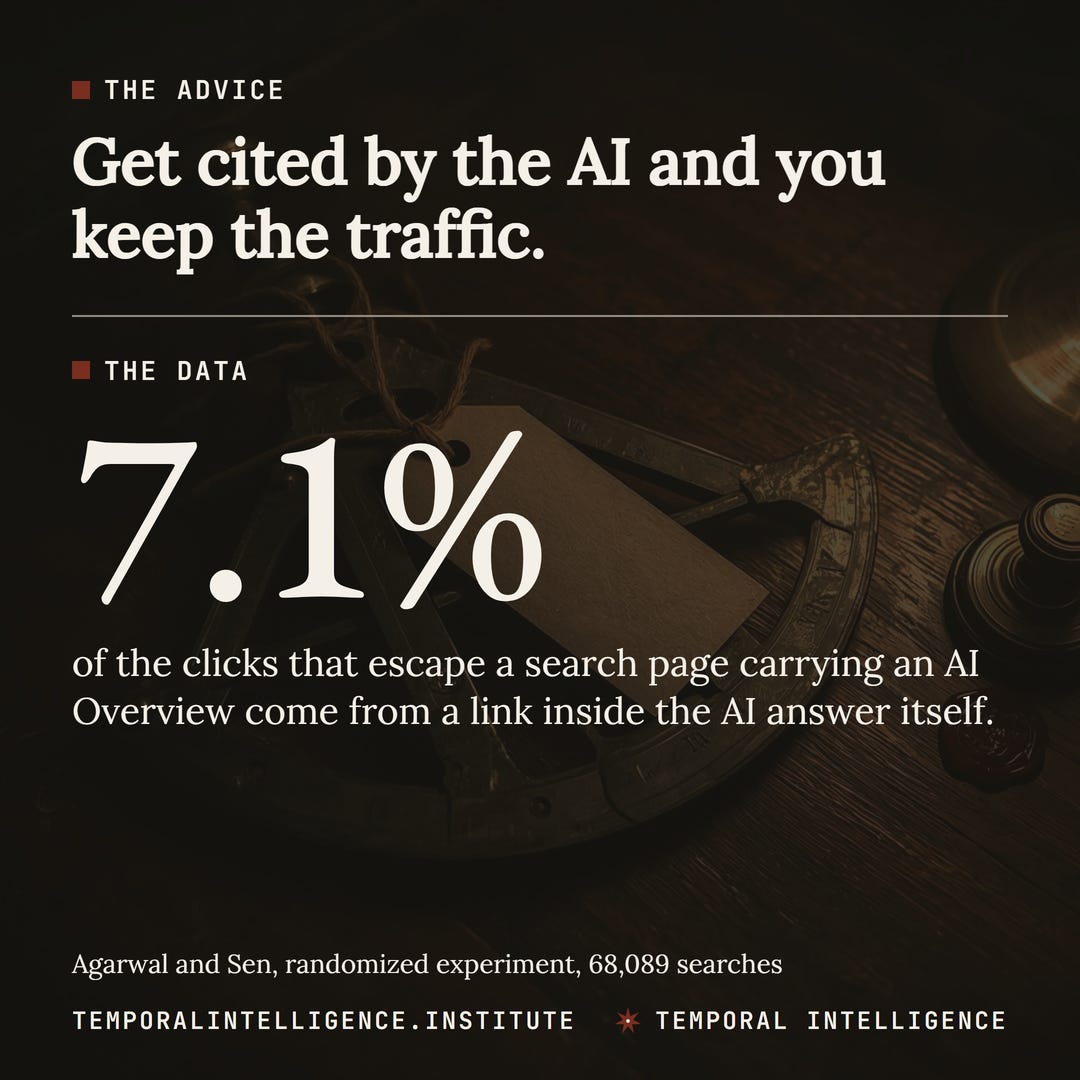
Per the same study, nearly entirely wrong: of the clicks that do escape a search page carrying an AI Overview, only 7.1% come from a link inside the AI-generated answer itself.
The technology is the least interesting part of that story.
The interesting part is that an entire industry adopted a confident, specific, endlessly repeated prescription... and nobody went back and checked whether the thing it assumed was actually happening.
A separate study, out of the University of Chicago and the University of Toronto, ran a narrower question on 393 participants, with its method locked and published before a single result came in.
Does having an AI assistant help you think.
The answer was neither yes nor no. It was a reversal.
Access to the assistant from the start of a task improved performance when time was short, and hurt it when there was enough time to think the problem through properly.
Same tool, same task, opposite result - turning entirely on the one variable nobody in this argument ever names, which is how much time you actually had.
You’re hearing 2 answers to all of this right now, from people worth listening to, and both of them are a way of not checking.
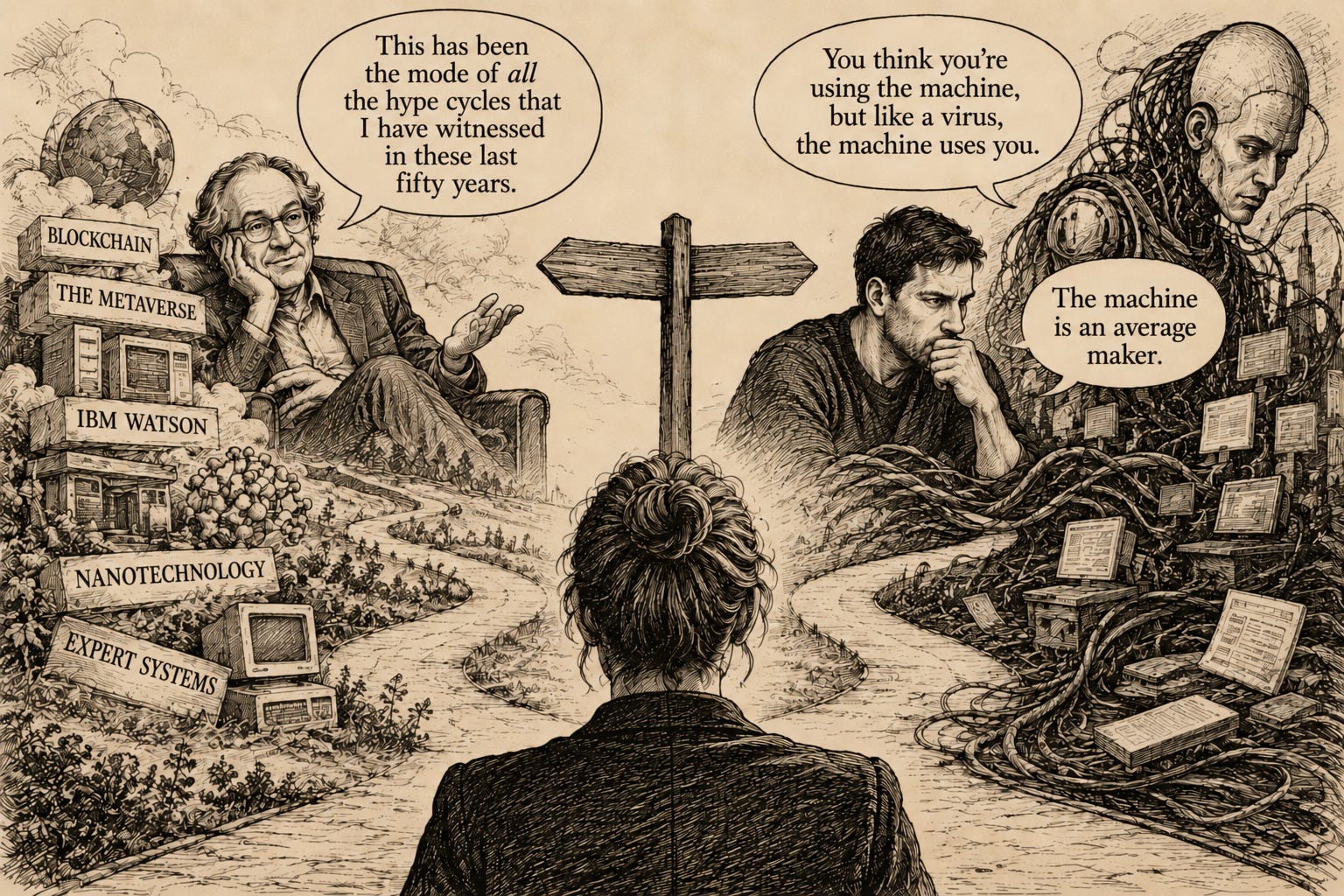
One camp says relax, you’ve seen this before. Rodney Brooks, who helped found the robotics and AI fields, makes that case as well as anyone.
Blockchain. The metaverse. IBM Watson. Nanotechnology. And, in his words, “expert systems which were going to capture all the knowledge of experts and let companies lay off their workers.”
All of them promised to swallow the economy, and then quietly didn’t.
He’s usually right about hype, and I wouldn’t bet against him casually. What’s missing is the check.
That conclusion, exactly like its opposite, was reached without measuring it against the conditions that make this cycle different from the 5 he just listed.
The other camp says the opposite with equal conviction. 2 weeks ago Brad Stulberg put it about as sharply as it can be put: “you think that you’re using the machine, but like a virus, the machine uses you.”
And, on why he keeps some of his own work away from it entirely, “the machine is an average maker.”
That’s a real argument, made by a serious person, and the fear underneath it is the one I hear from founders up at 3am worrying that whatever they built their judgment on is moving too fast underneath them to still apply.
Also a conclusion reached without checking...
Both camps let you stop at the door. Neither one asks what the room actually looks like.
Here’s the check I’d run instead. I call it dating a pattern, and it’s 3 passes, in order, on any piece of your own judgment you’re currently defending or currently abandoning.
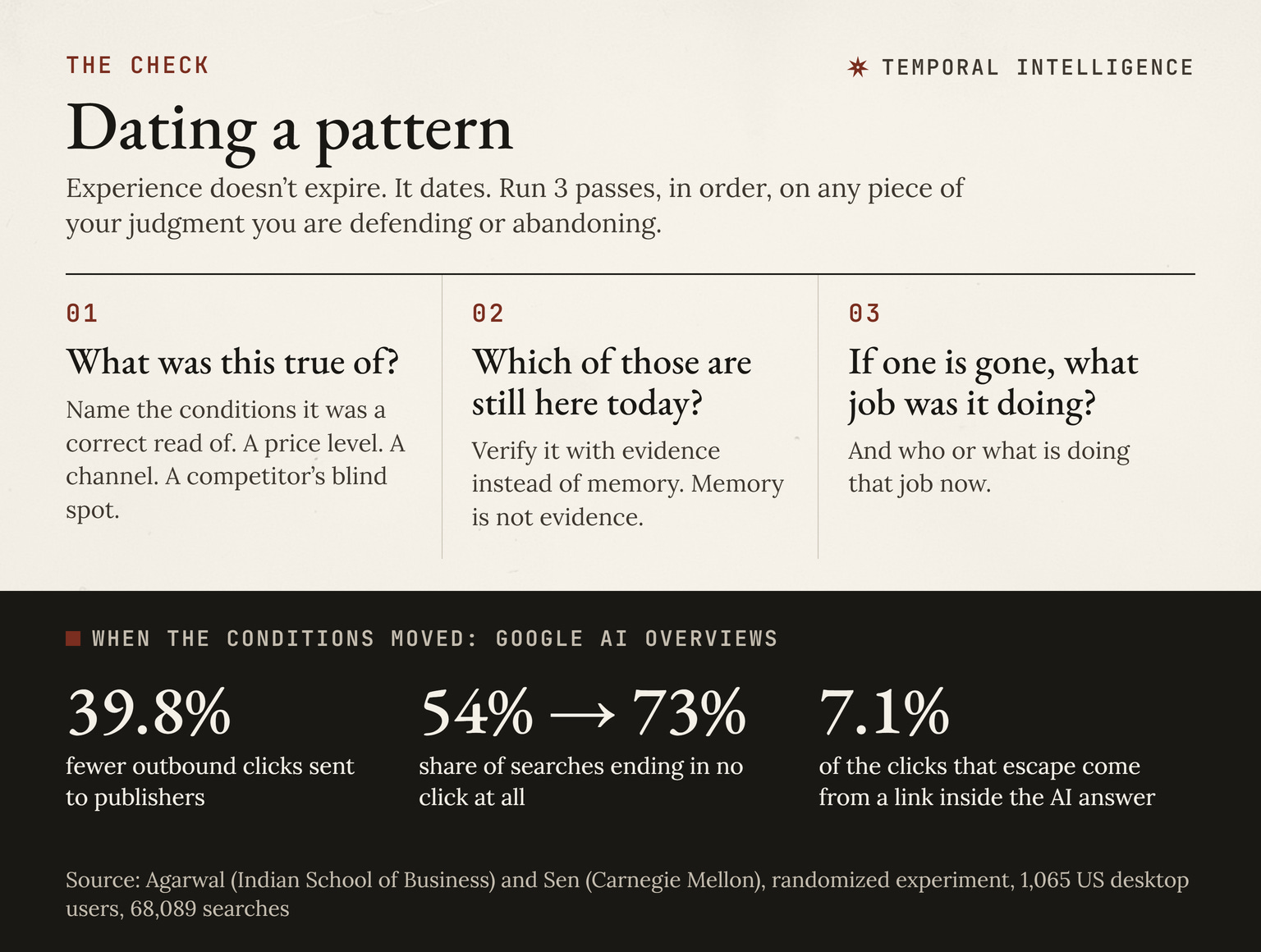
First: what was this true of.
Not is it still true, which just restarts the argument between the 2 camps. Name the actual conditions this pattern was a correct read of. A price level. A channel that behaved a certain way. A competitor’s specific blind spot.
Get it down to something a person could go and look at.
Second: which of those conditions can you verify is still here today, with evidence instead of memory.
Memory will tell you it’s still true. Memory is not evidence. It is a habit with a badge and an evidence baggy.
Third: if one of them is gone, what job was it doing for you, and who or what is doing that job now.
That’s it. It isn’t elegant and it doesn’t need to be.
A pattern that survives all 3 passes is a live read, and you should be backing it harder than you currently are.
I do this for a living, and the thing I almost never meet is a founder who has ever been taught to ask what their best method was actually true of.
We built this publication on one question. What kind of time is this.
Usually we ask it about a market, or a launch window, or a year. Ask it about your own expertise instead.
Not whether it’s obsolete. Not whether it’s fine. What it was true of, and whether that’s still where you’re standing.
Ric and I didn’t get worse. Neither did you.