

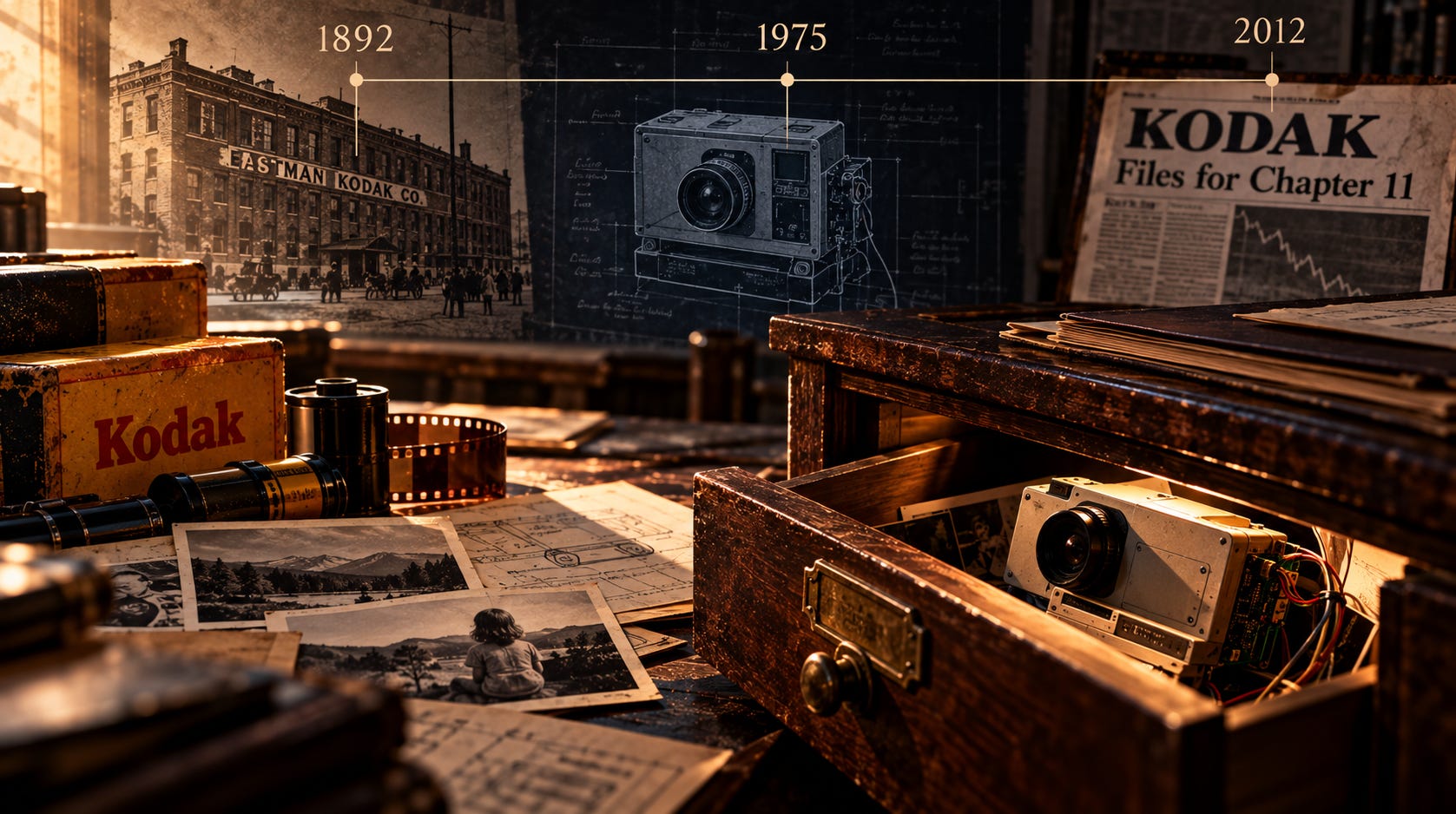
Kodak’s bankruptcy was decided in 1892, before the company shipped a single product.
You know the other version.
In 1975 a Kodak engineer named Steve Sasson built the first digital camera. He built it inside the company, on company time, with Kodak’s money.
The company looked at the thing that would end its business and put it in a drawer.
At its mid-1970s peak Kodak held roughly 90% of the US film market. It saw digital coming. It had built digital.
And in January 2012 it filed for Chapter 11.
If that story hits a little too close to home right now, you are not imagining it. Every founder I know is quietly running the same math about AI and their own category.
That is the story everyone tells, and it gets told as a story about people.
Smart executives who saw the future and flinched. A failure of vision, or of nerve, or of management.
I spent a while inside that explanation and it never held for me, because the people at Kodak were not fools and the evidence was not hidden from them. They were holding the future in their own hands.
The problem was never that they couldn’t see it. The problem was that they couldn’t keep it.
That is a different kind of problem, and it does not live in the people.
It lives in the structure they were standing in. And the structure was set at incorporation, on May 23, 1892.
Here is the fault, plainly.
Kodak was built to be an image carrier. Film is a thing that holds a picture in fixed form. That was not only the product, it was the company’s identity at the level of the load-bearing foundation.
An image cannot release its own form.
So when digital arrived, a way of holding a picture that dissolved the fixed form entirely, it arrived as a challenge to what Kodak fundamentally was, not just to what it sold.
The foundation had no way to hold both at once. The carrier and the thing that dissolves the carrier could not occupy the same structure.
One of them had to be given up. And the structure had already chosen which one the company would cling to, decades before Sasson plugged anything in.
I know how that sounds, so here is how we read it.
We built an instrument that reads a founded thing, a company, an organization, a country, from its beginning. We call it the Founding Read.
It works from a date anyone can look up and against a record anyone can check.
It runs on several systems, developed by civilizations that never compared notes, that share no vocabulary and agree on almost nothing by design. Any one of them alone is easy to set aside.
When they converge, without coordination, on the same fault, the agreement is the evidence.
That is what Temporal Intelligence is: a read you can check against what actually happened.
The Institute keeps the definition of the read. It does not make the read true. The record does that, and the record on Kodak is more than a century long.
After running the Read we did something that made it even harder to set aside.
We sent it to one of the men who ran Kodak’s brand.
Jeffrey Hayzlett was the Chief Marketing Officer of Eastman Kodak. He read the diagnosis, and here is part of what he said back.
“Companies develop identities that become strengths until they become constraints.”
“Brands become myths internally. Employees begin believing the narrative more than the marketplace.”
That is the former CMO of Eastman Kodak naming, from the inside, the same fault the read had named from the outside, built from nothing but the founding record and the public numbers.
Two vantages, decades and a corner office apart, describing one structure.
He did not call it a rave. His word was “incomplete.” “Directionally right,” he said, “but like most analyses of Kodak, they’re incomplete.”
I would rather have that than a clean yes. A qualified confirmation from the person who lived inside the myth is worth more than an easy one, because he had every reason to defend the company and named the fault anyway.
What stays incomplete is never the fault. It is everything a company still gets to decide about a fault once it can finally see it.
Here is the part that follows you home.
Every company carries one of these. A single fault, set at the start, in the foundation, that the company will spend its whole life either obeying or fighting without knowing the fault is there.
The company you built has one. So does the one you are inside, and the one you are about to start.
It has a founding fault with your name near it, and in all the strategy decks and the board meetings and the quiet drives home, you have never once read the page it is written on.
Kodak’s people never read theirs either. That is the difference the reading makes.
Read the fault early and you get to decide what to do about it. Leave it unread and it decides for you, on its own schedule, the way it decided for Kodak.
The next time a famous company stumbles and the whole feed asks whether it is the next Kodak, that is the question underneath the question: what its founding record set it up to be unable to keep, long before any threat arrived.
That is the thing I keep circling in these letters.
The useful move is plain. Seeing the structure you are actually standing in, and reading what it is set to do, before it makes the call for you.
We ran the same read on the United States for its 250th, because that is a founding chart anyone can check against the record.
The claim is on the page and the record is public. If you want to test it before you trust it, reply, and I will answer.
Subscribe below and I will send you the full USA Founding Read, free, as our gift for the 250th.
