

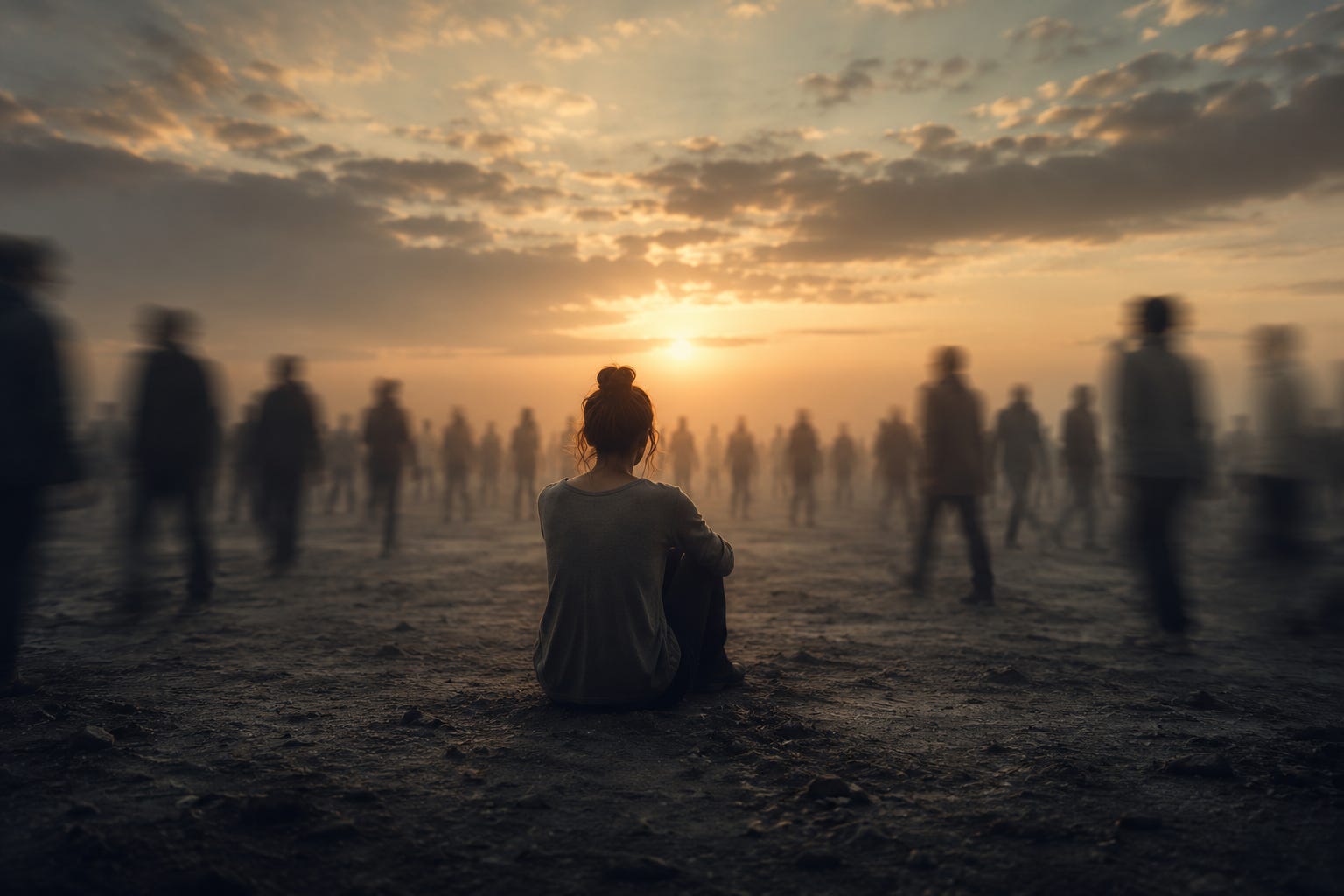
There is a word for what many people are experiencing that doesn’t get used much anymore.
Rootless.
Not homeless — most people have a roof.
Not friendless — most people have contacts, followers, connections, group chats.
Rootless in a different sense.
The sense of having no place that is genuinely yours — not a location, but a belonging.
A community where your absence would be noticed.
A ritual that marks time and says: this is what we do, these are our people, this is where we come from.
An elder whose opinion actually matters to you because they know your history and you know theirs.
Most of that infrastructure — the kind that used to form without effort because people stayed in one place long enough for it to develop — has become genuinely difficult to build or find.
People move more.
Work takes more.
The financial pressure that runs underneath everything makes community feel like a luxury that comes after the other things are handled.
Except the other things are never quite handled.
So the roots never form.
And you end up technically surrounded — by colleagues, by online communities, by the appearance of connection — while the thing you’re actually hungry for goes unnamed.
It isn’t more people.
It’s different contact.
Somewhere in the shift to digital everything, something specific got lost.
Not information — there’s more of that than anyone can metabolize.
Not communication — there’s more of that too.
What got lost was the texture of actual presence.
The conversation that happens because two people are in the same room with nowhere to be — not because they’ve scheduled thirty minutes on a shared calendar.
The meal where no one is performing for an audience and no phones are present.
The grief that gets witnessed in person, not managed through a thread.
The celebration that involves your actual body, in an actual place, with people who will remember it with you.
The digital version of all of this exists.
It is not nothing.
But it doesn’t do the same thing.
And most people know this — even if they can’t say exactly what’s missing, only that something is, and that scrolling doesn’t fix it, and that more connection in the digital sense doesn’t produce the feeling they’re reaching for.
My daughter-in-law mentioned recently that she’s noticed it in her generation and those younger — people who don’t quite know how to be in the same room anymore.
I’ve seen it myself.
Friends of my sons, sitting across a table from each other, texting rather than talking.
Not from rudeness.
From something that was never built — or that atrophied before it had time to set.
And I’ve seen it in my own generation too.
Different reasons, same result.
The muscle for presence — for being genuinely, uncomplicatedly in the room with another person — turns out to require practice.
Practice most people aren’t getting.
Real community costs something beyond money.
It costs time that feels indulgent when everything else is competing for it.
It costs proximity — staying somewhere long enough for the relationships to develop past the surface.
It costs showing up when you don’t feel like it, and letting people see you when you’re not put together.
Most people are running too hard, with margins too thin, to afford that consistently.
So the investment never quite gets made.
The roots don’t form.
And the hunger stays.
The people navigating this moment with the most steadiness — not without difficulty, but with more orientation than most — share something that isn’t obvious from the outside.
It’s not that they have better information, or better habits, or better frameworks for thinking.
It’s that they have a room.
Somewhere small.
Somewhere with people they can actually think with — not just agree with, but think with.
Where something can be said before it’s fully formed.
Where someone will push back without it costing the relationship.
Where there’s enough shared story and enough trust that genuine exchange is possible rather than managed.
That room is what most people are looking for when they say they want community, or depth, or to feel… less alone.
Most of them haven’t found it yet.
And the gap between what they have and what they’re actually hungry for is larger than the word “lonely” captures.
