



It worked. Then it stopped working, and nothing you’ve tried has brought it back.
You know the feeling. You’re blindfolded and handed a stick. You get spun around, and something shifts - your health, your team, your market, the world. Now you’re standing there unable to see, everyone’s shouting directions, and you’re desperately swinging at the thing you need to crack... while it keeps moving.
I call that the Problem Piñata. And this week Ryan Levesque wrote about the blindfold part.
His essay is titled “The Great American Apple LIE: The Danger of Soundbites, Personality Tests, & What AI Tells You... About You.” He opens with a line anyone over 30 can finish in their sleep: “An apple a day keeps the doctor ________.”
Turns out, that started as a Welsh folk rhyme, and apple growers trying to salvage their businesses during the Temperance movement of the early 20th century created an advertising campaign to rebrand apples away from their traditional use in Hard Cider and into a supposed health food. The advertising made the rhyme famous. The soundbite stuck. The rest of the story didn’t.
Then he turns the analogy on us. He says, “A personality test can be a useful mirror.” It can also reduce “the complex human being you are into a number, a color, a handful of words... A soundbite.”
And when we hand “who am I” to a test, a framework or a chatbot at 2 a.m., “we deprive ourselves of the important work of answering this question for ourselves.”
He’d know. He built a multi-million dollar empire on quiz funnels. His fix is 2 questions to run any advice through: “Is this true for me?” and “Is this true for now?”
He’s right on both. I’d go one step further, because the second question is the one that keeps people swinging at the Problem Piñata.
The blindfold has a name
I call them Blindfold Solutions: labels, soundbites, profiles, programs, playbooks.
They were the best ideas anyone had for how to solve a problem or make sense of why a person does what they do. Most of them were even true... of you, on the day they were made, or to solve a problem that may or may not be the thing that is actually wrong.
That’s the trouble. Each solution is a snapshot, and that snapshot could be a 1980s bad-hair-yearbook-picture, or a brilliant solution to a marketing problem that existed 10 years ago.

This worry about blindfolds, especially those related to technology, is nothing new. Diana Pasulka, who studies religion and technology, raised it on The Why Files podcast in August.
She went back to Plato’s Phaedrus: Socrates tells the story of an Egyptian king who was offered the gift of writing and isn’t impressed: “You have not discovered a potion for remembering, but for reminding; you provide your students with the appearance of wisdom, not with its reality.”
Socrates worried that the technology of writing moved memory outside us, and wisdom with it. The irony is that we only know about the worry because Plato took the story and wrote it down.
Pasulka’s point was that our latest technology-potion, AI-fed social media, is now doing the same to what she calls the “interior life.”
2,400 years later, we’re handing over the question of who we are to a chatbot.
And the machine does exactly what you’d expect.
On a recent Joe Rogan episode, he asked an AI about an obscure carving from an Egyptian tomb his guest was researching.
First it described it: figures in profile, and “the image alone is not enough to identify them confidently.”
His guest said “they’re just describing it,” and suggested giving it the name of the text. The answer that came back was the textbook one - a depiction of the underworld - no insight. And the guest said what anyone who reads those walls has heard 100 times: “It’s always the underworld. It’s always fertility. It’s always protection... that’s such a broad term.”
A description, or the standard label everyone gets. Neither one is an answer about what that wall actually means and why it was made that way.
Ask about yourself and you’re likely to get the former rather than the latter.
Why you can’t take the blindfold off yourself
A founder we work with sent all her marketing funnels to her son and asked why they weren’t working. He called back in seconds: “Because they don’t align with you.” Her first reaction when relaying the story to us: “You know how you can’t see your own ears?”
She’d built those funnels from a playbook she was handed years earlier. It was true for the industry, that year. It wasn’t true for her, now. She spent 2 months rebuilding every one.
That’s Levesque’s first question, and it needs someone outside you. His second question needs something more: a clock.
Because the Problem Piñata doesn’t actually move at random. You, your business, your market and the world each run on their own clock with their own strengths and constraints. They shift at different times. When one moves, and you’re aiming at another, you swing and miss... and then you decide the problem is you.
Seeing all of them at once, and where each one is in its own cycle, is what I mean by X-ray Vision. It’s the work we do.
We read each of those areas and the timing a person is in and hand it back in dated stretches - when one began, when it ends, and what it puts under pressure. It doesn’t predict events. It gives you dates your own life can agree or argue with.
You can start right now.
Draw your Piñata Map
It takes about 10 minutes, and you don’t have to give us anything to do it.
You’ll lay out the last 3 years on 4 lines: You, Your business, Your market and The world. You’ll mark the month it stopped working the way you expected, what changed on each line and when, and everything you tried since - the program, the relaunch, the new profile, working harder - on the line it was aimed at. The map draws itself as you go.
Then look at where your fixes sit, and where the changes sit.
Most people find they’ve been swinging at one line while a different one moved. That’s the Problem Piñata, in your own words. And nobody had to tell you who you are.
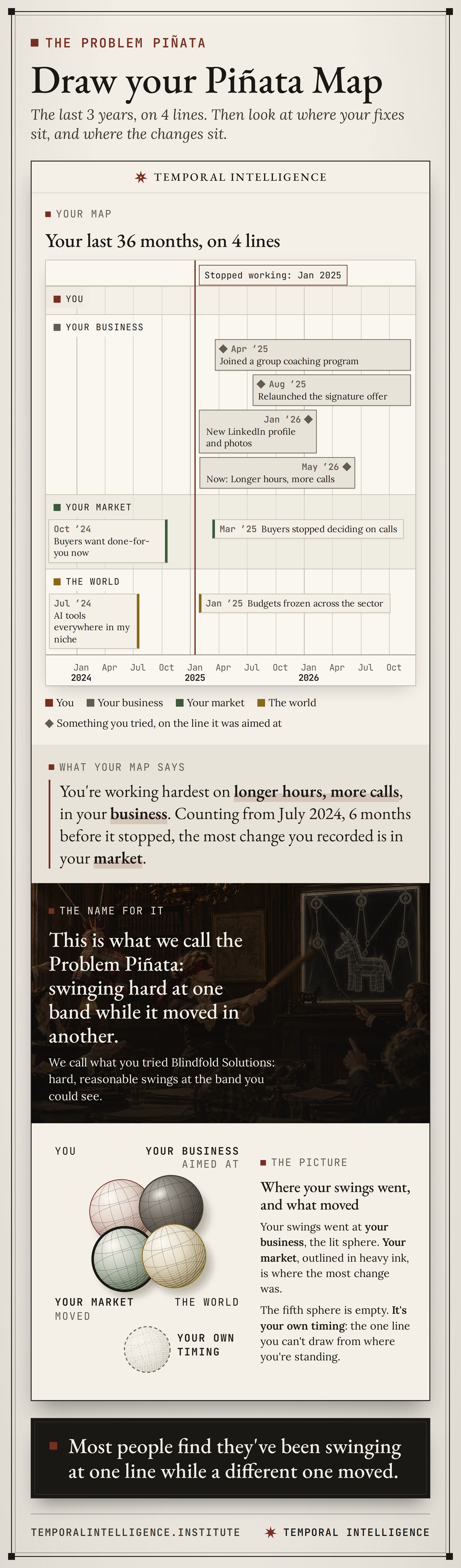
There’s one line you can’t draw from where you’re standing: your own timing. That’s the one that answers “true for now.”
So when your map is done, you can ask for your Timing X-ray.
We lay your own timing under the map you just drew - when each stretch began, when it ended, and what it tends to put under pressure - and you read it against what you wrote. You decide what fits.
Levesque closes with “Just don’t mistake the soundbite for the truth.” I’d add this: put dates on it, draw the whole picture, and then decide where to swing.
That lets you start to see through the blindfold with X-ray Vision.
Send this to a founder who’s been swinging at their own Problem Piñata lately. They’ll know.