



You’ve probably got a Black Friday template open in another tab. Your coaching package, 40% off, this weekend only, with a countdown timer somebody swore doubled their sales.
Your inbox has a wall of the same timers, all ending Friday the 27th at midnight.
Here’s what none of those timers can tell you: when your clients can actually say yes. And you already have a record of it that no template-seller has ever asked to see.
Look at the month your best offer sold. It isn’t a date to repeat. That month is a clue to what your clients were living when they said yes.
Read that clue right and you know whether this November is yours - or whether you’re about to discount your best work into a week your clients have no room for.
If you’d rather read your clients’ clock than a retailer’s, subscribe. It’s free.
Whose clock that timer is on
The timer in your other tab is set to a store’s clock, and the story of the name proves it.
In the 1950s, Philadelphia police called the day after Thanksgiving “Black Friday” because of what it did to the city: suburban shoppers jamming downtown, tourists in for the Army-Navy game, shoplifters working the crowds, and officers who couldn’t take the day off working extra-long shifts. The merchants hated the name. In the late 1980s, retailers rewrote it as the day the stores finally go “into the black.”
So the story everyone knows is a store’s story. Black Friday is the Retail World’s clock - the weekend a store builds its whole year to hit.
In the Problem Piñata I laid out the 4 clocks every founder lives inside. Here they get their names: the World Clock, your Market Clock, your Business Clock and your Personal Clock. From your desk, Black Friday is World Clock noise, set by retail. It comes through every inbox and feed you own, and none of it was set for you.
The Cookie-Cutter Consultants
On this Substack I’ve been naming the people who sell founders somebody else’s clock. The DoomSayers shout shrill predictions from the World Clock: the election, the economy, the next collapse.
This week we call out the Cookie-Cutter Consultants with their Script Pads in hand, writing Undiagnosed Prescriptions faster than the Keebler Elves can say Magically Delicious - trying to dictate your Business Clock.
A Cookie-Cutter Consultant writes every client the same prescription without looking at who’s in the chair. They haven’t had an original thought since... ever. And November is when they trot out the holiday-shaped scripts.
You know the ones. Run a Black Friday offer on your coaching package. Stack the bonuses. Put a timer on it. Do a Cyber Monday flash sale. Or, from the other half of the room, never discount, and raise your prices for January.
Every one of them takes its timing from the Retail World’s calendar, whether it tells you to sell into November or to hold out until it’s over.
Even the stores are tired of it. This month Denise Dunn, who founded an Australian footwear brand, described the pressure on small shops to SmartCompany: “you’ve got to offer at least a 20% discount, free shipping, and sometimes even a gift.” Her own brand is sitting Black Friday out.
To be fair: some programs are good. A program aimed at the problem you actually have, and built to fit how you work, can be exactly the right spend. The Cookie-Cutter Consultants are the ones who sell the same program as the solution to everyone’s problem without ever looking at what the problem actually IS.
What they never check are the 3 clocks that are actually yours: your Market Clock, your Business Clock and your Personal Clock.
Your Market Clock: what your clients are living right now
Your market is your clients - the actual people who buy what you sell - and their November looks nothing like a serial shopaholic’s.
A review season ends this weekend: the stretch of the year when people finish half-done projects, look back at systems and fix what comes back broken. Year-end reviews get written. Old files get opened. People hand out their verdicts on the year, including the one they quietly hand themselves.
Then comes the year-end close. Some of your clients have budget that disappears on December 31st. Some just had theirs frozen until January. Projects get pushed to “after the holidays.” Calendars fill with parties, travel, school concerts, and the family dinner they’re already rehearsing arguments for.
And their inbox looks exactly like yours. Somebody is counting them down too.
So most of your clients are tired and full. A few of them have just looked back at their year and seen something they want fixed. Those are 2 very different people, and a timer treats them as 1.
Your Business Clock: what you actually sell
Retail can run Black Friday because a store sells something you can drop in a cart in 30 seconds. A TV at 30% off is the same TV. It goes home in the box and works the same on Saturday.
You probably sell something else. A coach sells change that takes the client’s time, attention and nerve. A consultant sells a project that needs a budget line and somebody inside to own it. A practitioner sells work that asks the client to show up, more than once.
Nobody ever found 6 free hours a week because something was 40% off with a limited-edition tea towel thrown in.
That’s your Business Clock: what your offer needs from a client before it can work, and whether they have it to give right now. If your work needs room, and your client has none until the second week of January, a November deadline doesn’t sell your offer. It sells a start date your client can’t keep.
Some businesses do have a real November clock. If your clients buy sessions as gifts for their families, or have budget that vanishes at year-end, your Market Clock may well say now. Good. Then it’s yours, and you got there by looking for the evidence, not because some consultant handed you a turkey-shaped solution.
Your best month is a clue, not a calendar
This is where a lot of smart founders get caught. They look back, find the month their best promotion worked, and decide that’s their season.
Just because your best launch was in March doesn’t mean March is where it needs to happen again.
Ask what March was. What were your clients living that month? Maybe a new budget had just opened. Maybe they’d come out of a hard look at their year with something to fix. Maybe it was the first quiet stretch after a busy season, or the month a run of referrals came in. And you - did you have the energy that spring to sell like you meant it?
Whatever it was, that’s the clue. “March” is only the date it happened to fall on. The reason moves with your clients, wherever the calendar is.
A month is a date. A clue is a reason. Read the reason against where your clients are now, and only then decide whether the date still applies.
Your Personal Clock
The last clock is your Personal Clock, and it’s the one the Script Pads skip every time.
Most founders already sense that the World Clock isn’t the one running their business. In a Small Business Expo survey of 423 small business owners, posted November 2nd, 61.5% said their own business results have the greatest influence on their outlook. Just 5.2% named the national economy. What they don’t always check is whether the thing they’re selling fits the person doing the selling.
In June, a founder told Ric, my husband and co-founder, that she’d spent “a good 2 years talking and writing and creating what may have been courses.” Why? “Everybody always says, the one-to-many, you gotta write the course. I fell for it, because I didn’t know any better.”
Her verdict on those 2 years: “And wasted a lot of time and money.”
And the line I keep coming back to: “the whole time I was doing it, it never felt right.”
Later in the same call, she called 6 months with another advisor “an easy spend,” because, in her words, “this is what I like to do, is having the conversation.”
Same founder. The 2 years of courses never fit how she works. The 6 months did.
Ric told her the one-to-many model does work for a lot of people. Then: “nothing is one size fits all. We all know that. The question is, what size are we?”
A Black Friday script can’t ask that. It was written for a store.
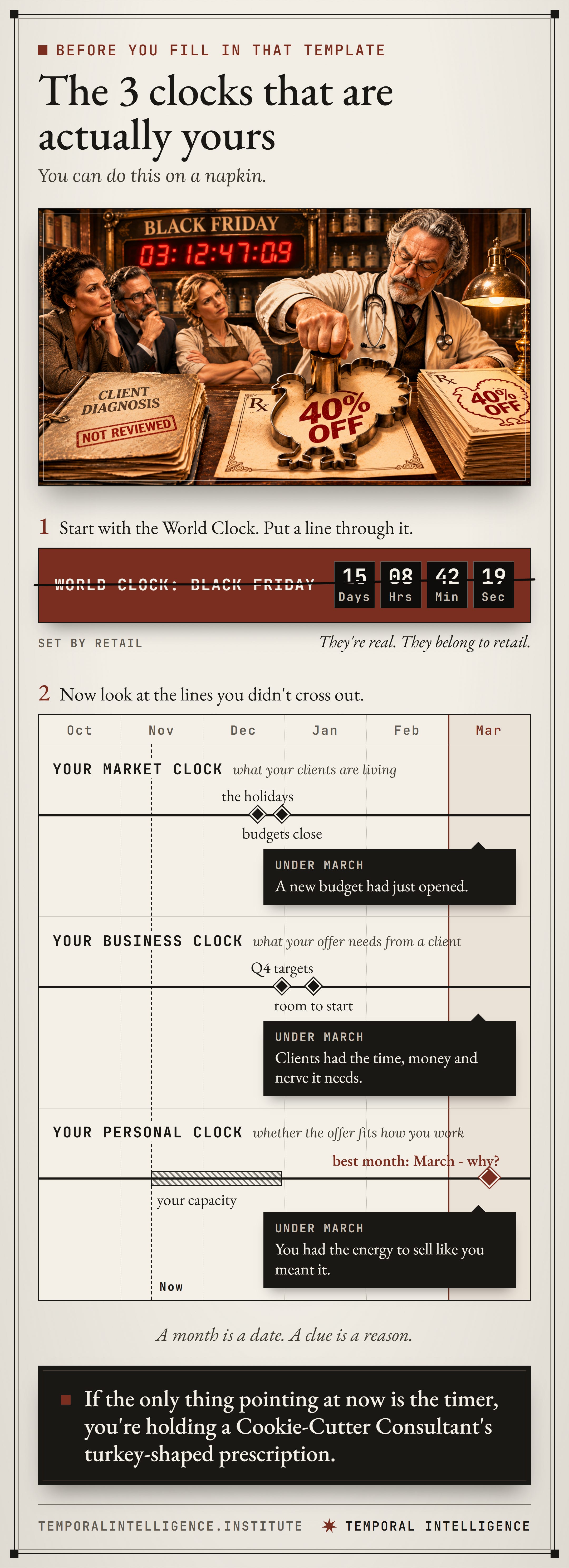
Before you fill in that template
You can do this on a napkin.
Start with the World Clock. Write down every deadline that hit you this week: Black Friday, Cyber Monday, the “last chance” from the program you bought 2 years ago. Then put a line through them. They’re real. They belong to retail.
Your Market Clock. Write 3 things your clients have actually said to you this month. Their words, not your guess. Budgets, the holidays, being tired, the thing they want fixed. That’s your Market Clock, in their language.
Your Business Clock. Write your business targets for the rest of Q4. Then look at what your offer needs from a client to work - time, money, a decision-maker, nerve. Next to it, write whether they have it between now and January. If those 2 lines don’t match, it takes real creativity to make them meet. But THAT is the work of a founder.
Your Personal Clock. Write your best month. Underneath it, write what your clients, your business and you were each doing that month. Then ask whether the offer you’re weighing fits how you work, the way that easy spend fit her. And don’t forget to take into account your own capacity for the rest of the year.
Now look at the lines you didn’t cross out.
If your Market Clock, your Business Clock and your Personal Clock all point at now, you have a November clock that’s yours, whatever the retail calendar says.
If they’re all pointing in different directions, that’s information too, and you have a bit of Temporal Engineering to do: shaping the offer and its start date to fit the clocks you actually have to work with.
If the only thing pointing at now is the timer, you’re holding a Cookie-Cutter Consultant’s turkey-shaped prescription.
If you’ve been swinging at the same problem piñata all year, draw the whole map. The Piñata Map takes 7 questions and shows you which clock the problem is actually on.
Draw your Piñata Map - https://www.temporalread.com/pinatamap/
Black Friday will be loud this year, like every year. Let it be. The stores earned their clock - they built a whole season around it and then rewrote the story of its name.
Your clients are most likely running a different one. Find out when they can say yes before anybody writes you a prescription.
If you’d rather set your offers by your and your clients’ clock than a retailer’s, subscribe. This is where I write about reading the clocks your business actually runs on before you take anyone’s advice.
Send this to a founder who's staring at a Black Friday template right now trying to figure out how to add turkey-shaped cookies to their offer at the 11th hour.