



Most founders I talk to carry a private list of verdicts about themselves. I’m bad at launches. I can’t make myself write. Something’s wrong with me about selling.
Some of those are real. And some of them were just the wrong 3 weeks, filed as a character flaw and carried around for a decade or more.
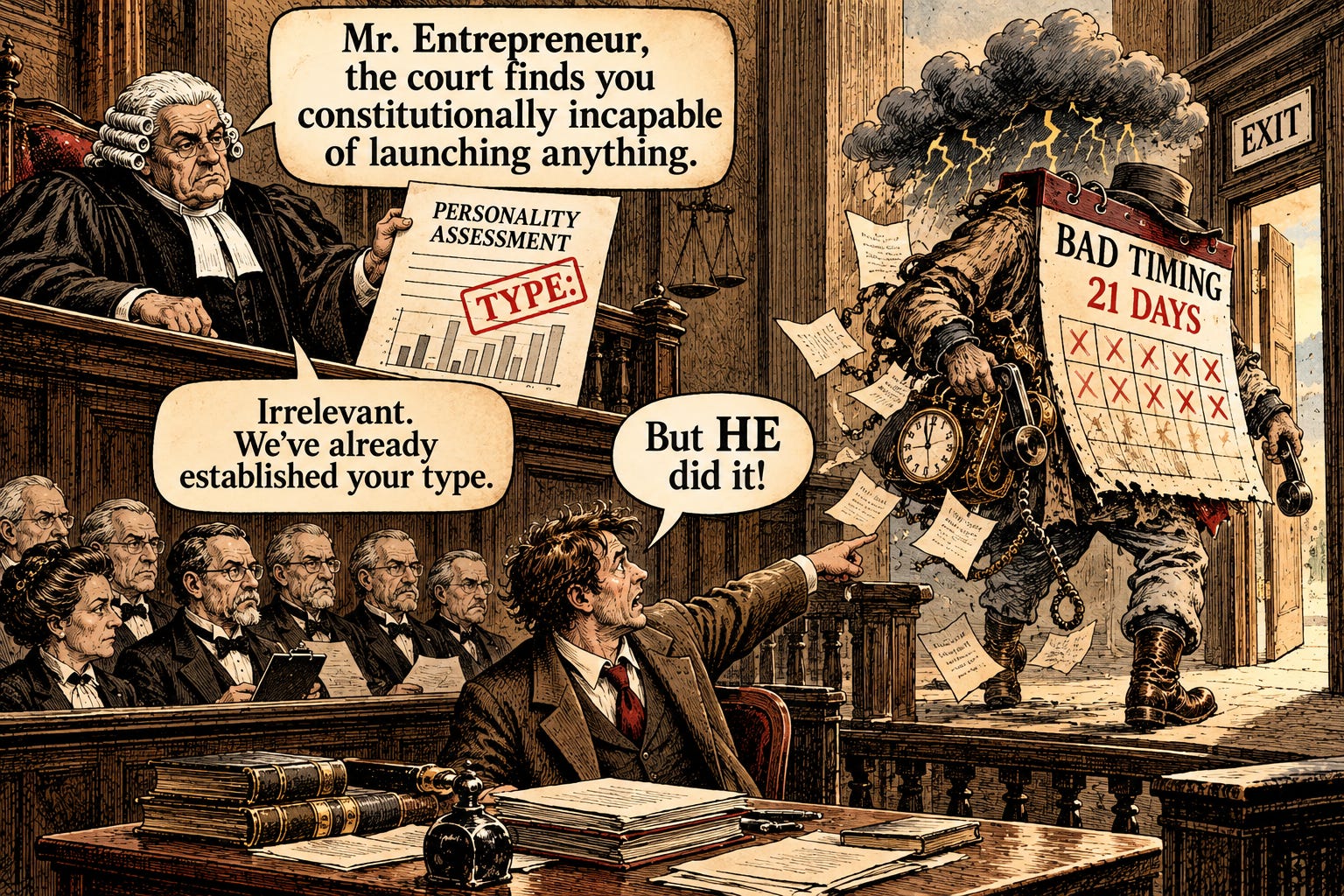
Every personality test you’ve ever taken can tell you something about the first kind. None of them can spot the second, because none of them ever asked when.
If you’ve been in business for any period of time, you’ve probably taken them all. The 4-letter type. The profile with the bar chart. The one your whole staff took as part of a team-building exercise and compared over lunch. Some of them you probably loved. Others, not so much.
I’m not here to knock any of those systems. They were the best anyone could do at the time, and they did what could scale: a fixed set of questions, a fixed set of answers, and a result you could hand a whole company by Friday.
But look at what a type actually is. It explains how you react to a set of questions about yourself at a certain point in time.
The people who publish the best-known of those tests have more or less said so themselves. Their current version reports, for each of the 4 letters, how likely you’d be to get the same result if you took it again... What those numbers can’t tell you is why.
I like that they measured it. It means the answer can move between sittings, and the publisher knows it.
Some of the wobble is the questionnaire.
Some of it is you, on a different afternoon, in a different stretch of your year.
Nobody asks which.
I learned to ask it years before I had a name for it.
In 2001, my husband Ric and I owned an internet service provider. We started with dial-up, and by the time we sold it in early 2003 we’d taken it to satellite. Support meant a person on our team picking up the phone and walking each customer through whatever was breaking that day.
The calls came in waves. 3 or 4 times a year, for about 3 weeks at a stretch, the same kinds of problems piled up together. Some of those weeks we had a generator running outside the window, extension cords strung everywhere, just to keep the servers up.
Nobody on the team had changed, and neither had the customers.
What changed was when.
It happened on a schedule we could feel before we could explain. So we chased it, and eventually we mapped it.
It was 2 years of our own phone lines, not a double-blind clinical study, and I know how what comes next sounds to anyone who’s run a P&L... But the waves lined up with Mercury retrograde, which comes around about 3 times a year for about 3 weeks a stretch.
At the time I thought mercury was the stuff in your grandmother’s thermometer and retrograde probably meant bad fashion decisions from the 70s or 80s. I knew nothing about astrology, but the calendar doesn’t lie and the line-up was too clear. It was enough to make us start paying attention to when, and we never stopped.
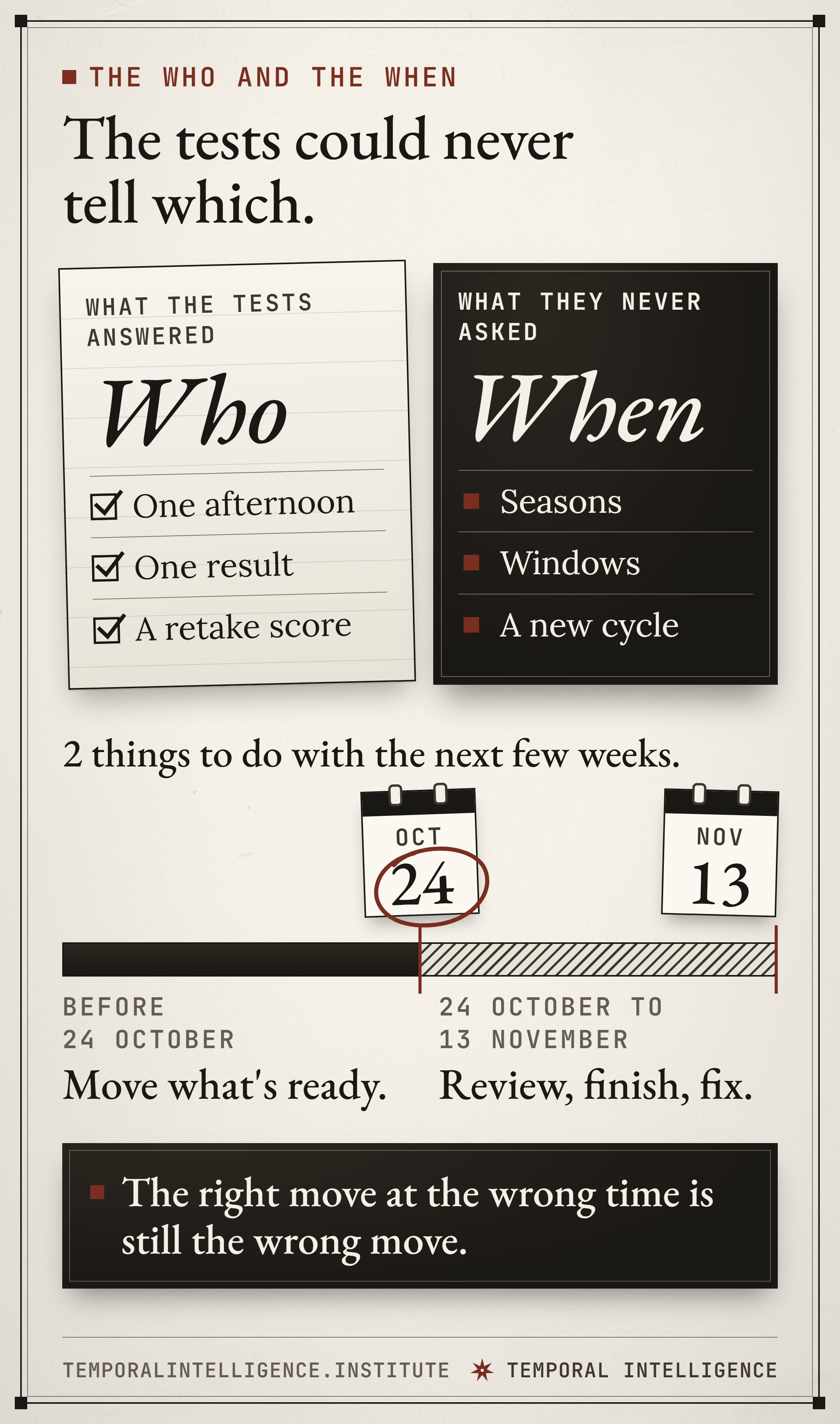
So don’t take my word for it. Check it against your own records. The last one ran from June 29th to July 23rd. Look back at what went sideways in your business and communications in those weeks, and what didn’t. The next one runs from Saturday October 24th to November 13th. That’s a better test than anything I can tell you.
That’s the when.
Here’s the who.
Actors have a word for what those tests and assessments did to the rest of us.
You get handed one part and you’re expected to play it forever.
Your answers on those tests were yours, but the boxes they sorted you into were written before you ever sat down.
So we use 2 words, and they travel together.
Typecasting assigns you a role from someone else’s script. The sorting hat assigns you to Hufflepuff.
Timecasting discovers the role you’re living now. THAT is what we do.
A founder we worked with this summer had a book he wanted to start, plus a couple of other projects he’d been asked to join. The timing work we’d done for him said to finish what was open before starting anything new, and it put a date on the shift: August 7th. He took it from there.
His reaction, word for word: “August 7th. Don’t do anything new until the 7th, got it.”
Then: “And it’s like, oh, God, thank you for permission.”
Nobody had told him he was the wrong kind of person to write a book. He’d heard that the next few weeks were for finishing, and he took that as permission to clear the decks before his next big project, rather than feeling like he had to do everything at once.
Another founder, 15 years into running his own firm, had a long, detailed report from us on how he’s built before our call. Near the start, before we’d gone through any of it, he said what he most wanted to learn was “how do I use these insights?” A few seconds later: “Because I didn’t get that far.”
Later in the same call: “having been through all kinds of assessments, this thing is very relevant to me.”
Knowing who he was had never been his problem. Nobody had told him what to do with it, or when.
Look at what’s being offered right now to people in exactly that spot. Career change gets framed, more and more, as an “identity” question.
There are online summits, famous personal-development names on the bill, promising an identity reset.
When AI takes someone’s job, the story gets written as a loss of identity.
Every one of those starts from the same assumption: if things stopped working, the person has to change.
Sometimes that’s true. But often, nothing about who you are needs changing at all. You’re still the same you - just the conditions moved around you, and you’re reading a timing problem as an identity problem.
And there’s a second pull at the same time. A review of 19 studies found that working with AI makes people’s creative output more homogeneous.
One force tells you to become somebody new. The other one quietly makes you sound like everyone else. Neither asks what time it is for you.
The right move at the wrong time is still the wrong move.
So is a new identity bought to fix a bad stretch.
2 things to do with the next few weeks.
Before Saturday the 24th, get the thing that’s ready moving. The proposal, the hire, the page, the conversation you keep rescheduling. Ship it now.
Then, from the 24th to November 13th, don’t launch the next new thing. Use those 3 weeks the way that founder used his: finish, review, fix what comes back.
And while you’re looking back, take out that private list of verdicts. Check which of your “I’m just not good at X” turn out to have been “that was the wrong 3 weeks for X.”
Before you sign up to reset who you are, find out whether it was only when.
No worksheet. A notebook will do, and so will the back of a napkin.
Then maybe you can stop fighting who you are, and see when to move.
Subscribe - it’s free - for more on the when half: what’s shifting, when, and how to tell in your own business.
Forward this to a founder who's taken every test going and still can't tell you when to move